
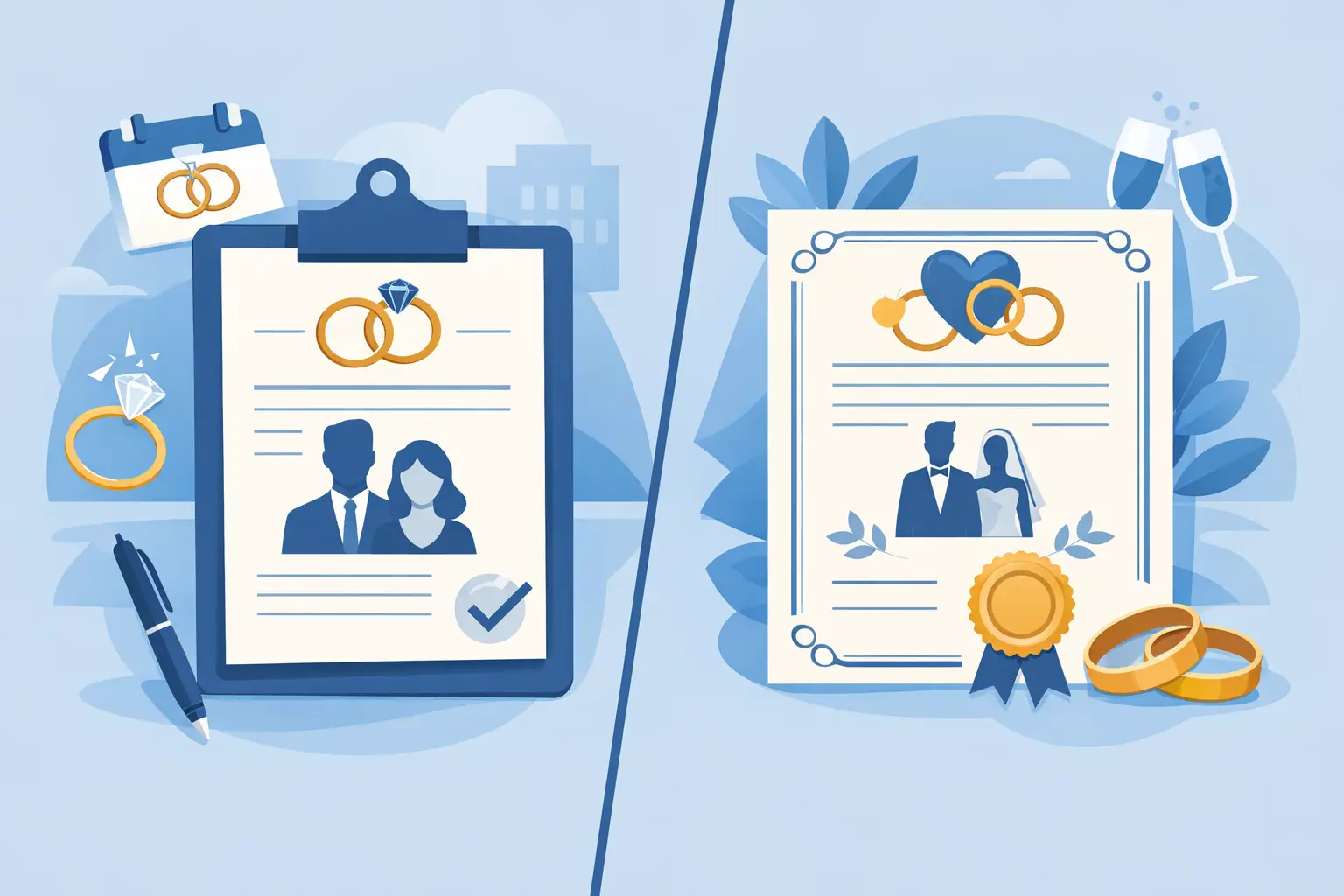
You are ready to say “I do,” but one question can stop an otherwise simple plan: marriage license versus certificate – which one do you need, and when? In Los Angeles, the answer matters because the license lets your legal marriage happen, while the certificate is the proof you use after it does. They are connected, but they do very different jobs.
For couples facing a military deployment, insurance deadline, immigration appointment, family milestone, or simply a spontaneous elopement, knowing the difference removes a lot of pressure. You can have a meaningful ceremony today and still make sure every legal step is handled correctly.
Marriage License Versus Certificate in California
A marriage license is permission to marry. You obtain it before the ceremony, and it confirms that you and your partner are legally eligible to be married in California. It is not, by itself, proof that you are already married.
Once an authorized officiant performs your ceremony, the license is completed and signed. It is then returned for county recording. That completed and recorded marriage record is what allows you to obtain certified proof of marriage.
A marriage certificate, often called a certified copy of a marriage certificate or certified marriage record, is the official document you show after the wedding when an agency, employer, bank, insurer, or other institution needs proof that you are legally married.
Think of it this way: the license gets you to the ceremony. The certificate helps you move forward after it.
The license comes first
In California, a marriage license must be issued before the legal ceremony takes place. Couples generally need to appear together, present valid government-issued photo identification, and confirm that they are free to marry. California does not require a blood test or a waiting period, which is why a properly organized same-day marriage is possible.
The license is valid for 90 days from the date it is issued. Your ceremony must happen during that window. If it expires before you marry, you will need a new license.
A license is also specific to the state. A California marriage license can be used for a ceremony anywhere in California, but not in another state or country. If you plan to marry outside California, confirm the rules where the ceremony will occur before obtaining documents.
The certificate comes after the ceremony and recording
After your legal ceremony, the officiant completes the license and it is submitted for recording with the appropriate county office. Once recorded, the county can issue certified copies of the marriage record. Those certified copies are commonly what people mean when they say “marriage certificate.”
A certified copy carries official certification from the county and is the document most organizations want to see. It may be needed when adding a spouse to health insurance, applying for benefits, changing a name, updating certain government records, handling taxes, or proving marital status abroad.
The timing depends on how and when the completed license is submitted and recorded. If you have a deadline, do not assume that a decorative certificate from a ceremony is the same as a county-certified record. Ask exactly what proof you will receive, what has been submitted for recording, and when certified copies will be available.
A Keepsake Certificate Is Not Always Legal Proof
Many couples receive a beautiful certificate at their ceremony. It can be wonderful for photos, framing, and remembering the day. But a ceremonial keepsake is not automatically the certified document accepted by a government office, employer, or financial institution.
This is one of the most common sources of confusion. A keepsake certificate celebrates your marriage. A certified copy proves your marriage for official purposes.
If you need documentation quickly, say why when arranging your ceremony. The right process can be planned around your situation, whether you need to meet a benefits enrollment deadline, prepare paperwork for an overseas use, or simply want certified proof in hand as soon as possible.
Public and Confidential Licenses: Why the Type Matters
California offers public and confidential marriage licenses. Both create legal marriages when the ceremony is properly performed and the completed license is recorded. The main difference is access to the record and certain ceremony requirements.
A public marriage license is part of the public record after recording. It requires at least one witness at the ceremony. A second witness may also sign, but is not required.
A confidential marriage license is available to couples who state that they are already living together as spouses. It is not available for general public inspection, and no witness is required at the ceremony. Certified copies of a confidential marriage record have more restricted access, generally limited to the spouses unless a court order allows otherwise.
Neither option is inherently more valid than the other. The right choice depends on your privacy preferences, living situation, and ceremony plans. If privacy is a major priority, discuss it before the license is issued – changing course later may create unnecessary delays.
What Happens Between “I Do” and Official Proof
The legal path is straightforward when every step is coordinated. First, the marriage license is issued. Next, an authorized officiant performs the ceremony before the license expires. Then the officiant completes the required portions of the license and submits it for county recording. Finally, you obtain certified copies of the recorded marriage record when needed.
Small details matter at every stage. The names, birth information, signatures, license type, witness information for a public license, and officiant details should all be accurate. A correction after submission can take time, so review the information carefully before signing.
This is especially important if either spouse plans to use a new legal name. California marriage paperwork may allow certain name choices, but a marriage certificate does not automatically change every record in your life. You will still need to follow each agency’s process for updating your Social Security record, driver’s license or ID, passport, bank accounts, employer information, and other documents.
How to Get Married Today Without Confusing the Paperwork
A courthouse route can work, but it can also mean separate appointments for the license, ceremony, recording, and certified copies. For couples on a deadline, those separate steps are often the real obstacle.
An end-to-end authorized service can coordinate the license, legal ceremony, county recording, and certificate support in one plan. Same-Day Marriage helps couples complete those steps in Los Angeles without treating their wedding like a stack of disconnected errands. You can choose an intimate chapel ceremony, a mobile ceremony at a meaningful location, a Spanish-language ceremony, or a more private VIP setting while keeping the legal process clear.
Bring valid government-issued photo identification and be prepared to provide accurate personal information. If you were previously married, be honest about the date that marriage ended. If you are visiting from another state or another country, California generally does not require residency or U.S. citizenship to marry here, but your identification and any later document-use requirements should be reviewed in advance.
For international use, you may need more than a certified copy. Some countries or foreign authorities require an apostille or additional authentication. That is not part of becoming legally married, but it can matter greatly after the ceremony. Planning for it early helps prevent a fast marriage from becoming slow paperwork later.
When You Will Need a Certified Marriage Certificate
You may not need a certified copy the minute your ceremony ends, but it is wise to order one before an urgent need arises. Institutions commonly request certified proof when you are changing a name, enrolling in a spouse’s benefits, applying for a mortgage together, documenting military benefits, or completing immigration-related paperwork.
Some organizations will accept a clear copy for an initial review, while others require an original certified copy. Because requirements vary, many newly married couples keep more than one certified copy. It is often easier to have the right document ready than to pause an application while waiting for another order.
The emotional moment and the legal moment can happen on the same day. Your ceremony is where you make the commitment. The correctly issued license, completed ceremony, county recording, and certified proof are what make that commitment easy to demonstrate wherever life takes you. If today is your day, let the paperwork support the celebration instead of delaying it.