
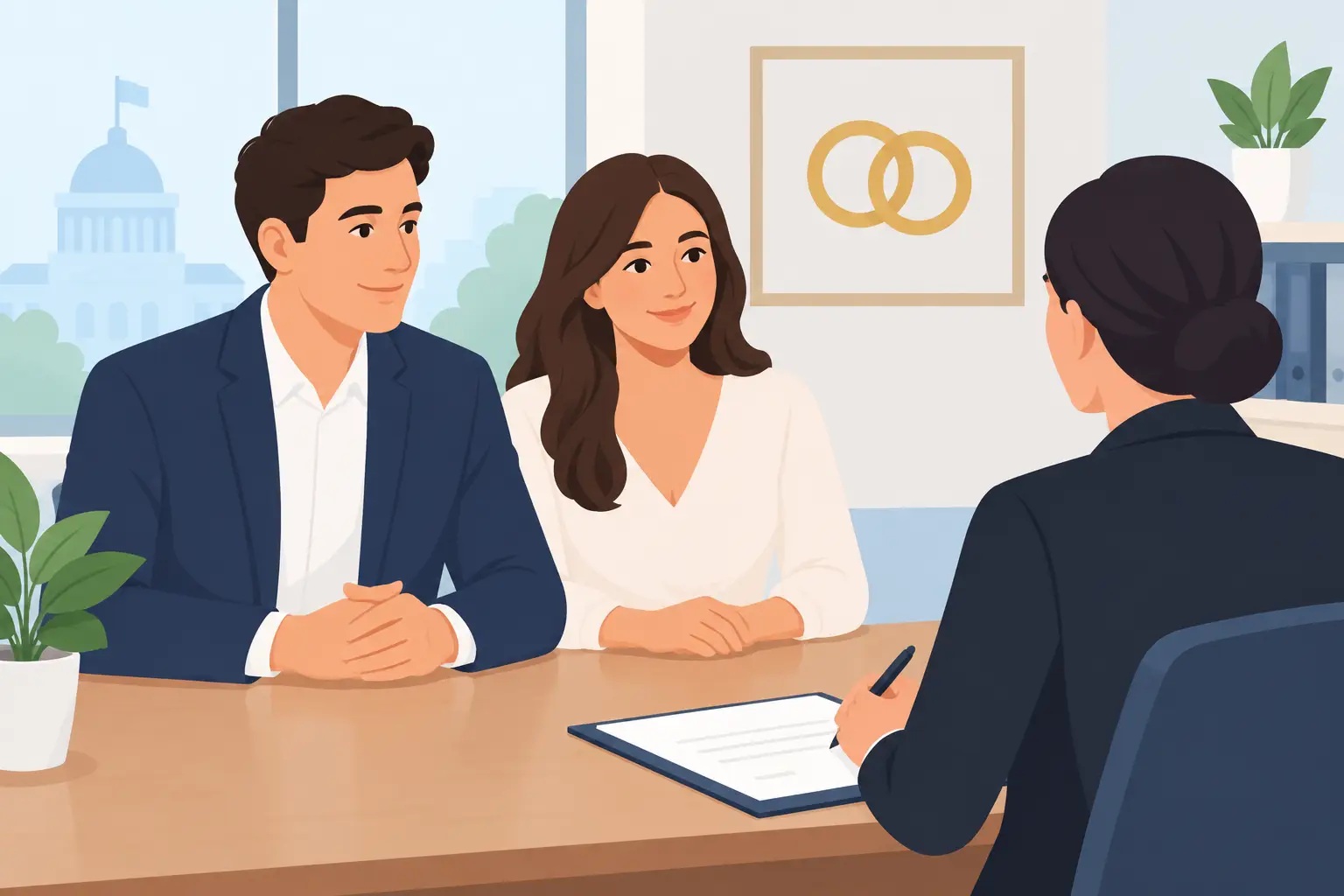
A last-minute wedding plan can raise one very practical question: do both partners attend the marriage license appointment? In most California marriage situations, yes. If you want to receive a marriage license, complete a legal ceremony, and have your marriage recorded correctly, both people getting married need to be involved in person. The good news is that this does not have to mean courthouse lines, separate appointments, or a week of administrative stress.
For couples who are ready now, understanding when you both need to appear helps the day move quickly. Whether you are eloping in Los Angeles, handling a military deadline, visiting from another state, or simply choosing love over a long engagement, the process is built around both partners giving their consent and providing accurate information.
Do Both Partners Attend for a California Marriage License?
Yes. For a standard California marriage license, both partners generally appear together in person to apply. You will each present valid government-issued photo identification and provide the information required for your marriage record. This is not paperwork one person can usually pick up for the other.
That joint appearance protects both of you. A marriage license is more than a form. It is the legal authorization for your ceremony, and the information on it becomes part of the official record after the marriage is completed and recorded. Both partners must be able to confirm their identity, age, and intent to marry.
If one of you is coming from another state or another country, that does not automatically prevent you from getting married in California. California licenses are available to eligible couples regardless of where they live. What matters is meeting the identification and legal eligibility requirements and appearing together for the licensing process.
There is one narrow category of exceptions that may apply to active-duty military members who cannot appear because of service. Proxy marriage rules are highly specific and are not a casual workaround for travel, work schedules, or convenience. If this may apply to your situation, get professional guidance before making plans.
Both Partners Are Needed for the Ceremony, Too
A license alone does not make you married. You become legally married when an authorized officiant performs your ceremony after the license is issued. For a normal California ceremony, both partners must be present to make their declarations and participate in the marriage.
The ceremony can be brief, private, emotional, funny, traditional, or completely simple. It can happen in a chapel, at home, at a hotel, outdoors, or at another approved location that feels right for you. What cannot be skipped is the legal core: the license, an authorized officiant, your mutual consent, and the proper completion of the marriage paperwork.
Many couples worry that a legal ceremony will feel rushed or impersonal if they need to get married today. It does not have to. A short ceremony can still include vows, rings, a kiss, photos, and the people who matter most. The legal requirements are straightforward, leaving room for the moment to feel like yours.
Public and confidential licenses have different witness rules
California offers public and confidential marriage licenses, and the right option depends on your circumstances. A public marriage license requires at least one witness to sign the marriage license after the ceremony. You may have a second witness if desired.
A confidential marriage license does not require a witness, but it has its own eligibility rule: the couple must already be living together as spouses. It also carries different record-access rules. This option can work well for couples who value privacy, but it is not simply a way to avoid bringing anyone else along.
In either case, the two people getting married still need to be present for the license and ceremony. Your provider can help you confirm which license type fits your situation before the day begins.
What Each Partner Should Bring
The fastest way to protect a same-day marriage plan is to prepare together. Each partner should bring valid, unexpired government-issued photo identification. A driver’s license, state ID, passport, or other accepted government photo ID may work, depending on the document and your circumstances.
You should also be ready to provide your current legal name, date and place of birth, parents’ names and birthplaces, and details about prior marriages if either of you has been married before. If a prior marriage ended recently, be accurate about the date it ended. The purpose is not to make your day complicated. It is to ensure the marriage license is completed correctly from the start.
If either partner has a unique documentation issue, such as a name difference across records, an international passport, a previous divorce outside the United States, or uncertainty about an ID, ask before you arrive. A quick confirmation can prevent a stressful surprise on a day that should feel exciting.
Can One Partner Arrive Later?
You can arrive separately at the location, but you cannot complete the key steps separately. Both partners must be there when the marriage license is issued and when the ceremony takes place. If one person is delayed, the process generally waits until you are both present.
This is why timing matters, especially if you have a flight, deployment schedule, courthouse deadline, hospital visit, immigration consultation, or family event later that day. Build in enough time to review your information carefully, complete the ceremony without feeling pressured, and handle any documentation questions before you leave.
For couples who want an intimate location ceremony, logistics can take a little more coordination. Mobile officiation may involve travel timing, parking access, venue rules, and witness planning for a public license. A chapel ceremony can be the simpler choice when speed and certainty are the priority. Neither is more legally valid. The best choice is the one that lets you both be present, relaxed, and ready.
What Happens After You Both Say “I Do”?
After the ceremony, the completed marriage license must be returned for recording with the Los Angeles County Clerk Recorder’s Office. Recording is the step that creates the official government record of your marriage. A souvenir certificate or ceremony keepsake can be meaningful, but it is not the same as a certified copy of the recorded marriage record.
This distinction matters when you need legal proof for name changes, health insurance, military benefits, immigration matters, banking, taxes, or other official purposes. Couples facing a deadline should ask how the recording process and certified-copy support will be handled before they book. Fast should still mean legally complete.
Same-Day Marriage can coordinate the license, authorized ceremony, county recording, and certified-proof support in one guided process, so you are not left trying to connect separate offices after your vows. That is especially helpful when you need a valid marriage completed now, not an appointment weeks from now.
A Quick Way to Plan Your Day Together
Start by deciding whether you want a chapel ceremony or a ceremony at your chosen location. Then confirm that you both have acceptable photo ID and can attend at the same time. If you need a public license, decide who will serve as your witness. If privacy is a priority and you already live together, ask whether a confidential license is appropriate.
Keep the conversation honest about timing. One partner may be ready for a spontaneous elopement while the other wants a few minutes to call family, choose rings, or write a short vow. There is room for both urgency and intention. Getting married today does not require making the day feel careless.
The simplest answer is reassuring: plan to attend together. Bring your identification, show up ready to consent, and let the legal details be handled correctly around the commitment you are making. When both partners are present and prepared, a fast Los Angeles marriage can still feel personal, joyful, and fully official.