
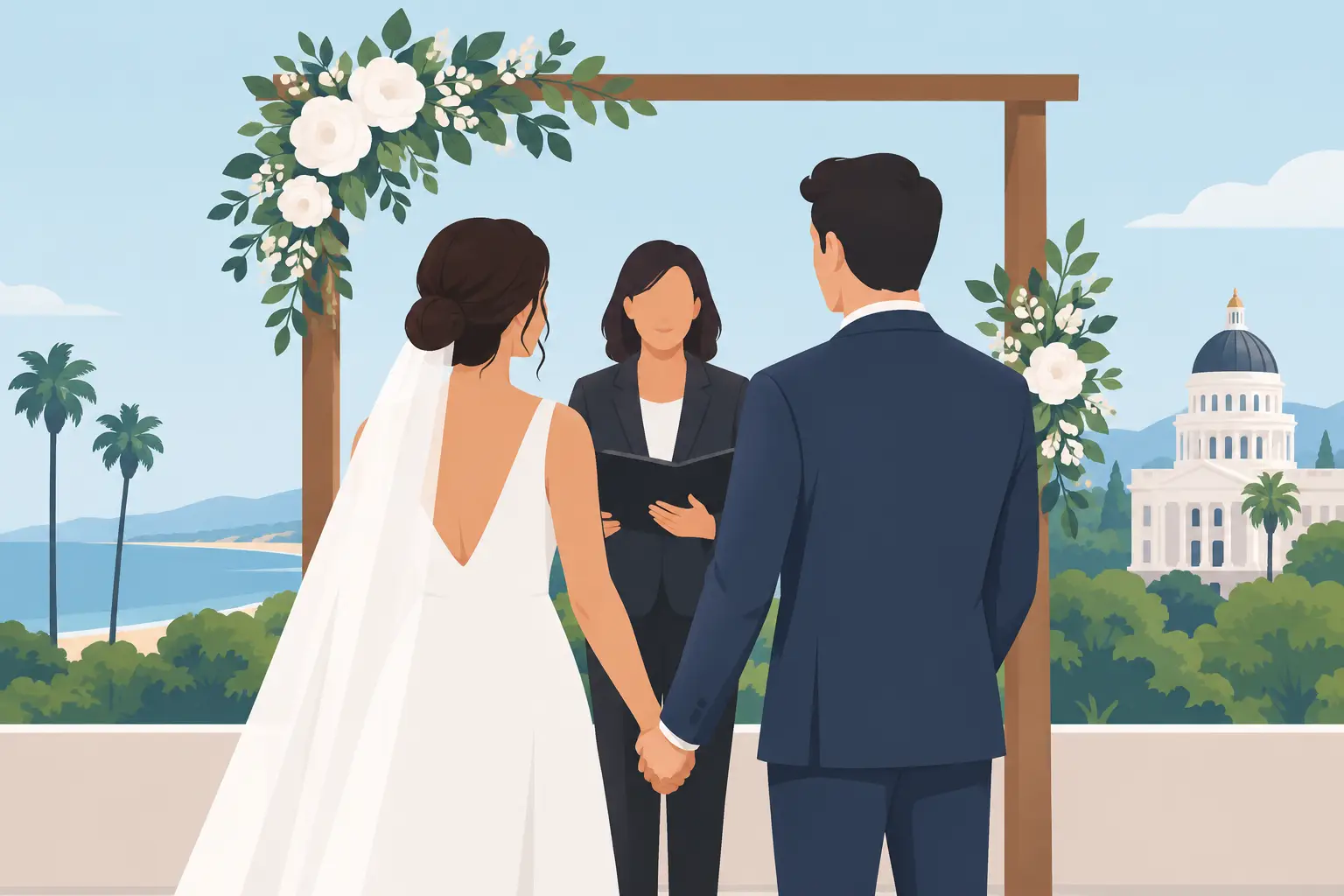
A last-minute marriage plan can bring up one very practical question: do both partners attend ceremony appointments in California? For almost every couple, yes. Both people need to take part in the legal process, from obtaining the marriage license through saying their vows and signing the marriage license after the ceremony.
That does not mean your day has to feel formal, crowded, or complicated. You can have a private chapel elopement, a simple signing with a meaningful vow exchange, or a mobile ceremony at a location that feels like you. The key is making sure the legal requirements are handled correctly while you stay focused on the reason you are doing this: choosing each other.
Do Both Partners Attend the Ceremony in California?
Yes. In a standard California marriage, both partners are present for the ceremony. A licensed or authorized officiant conducts the ceremony, both parties consent to the marriage, and the marriage license is completed and signed as required.
A marriage is not simply a document one person can pick up, sign alone, and take home for the other person to sign later. The license and ceremony work together. You apply for the license, complete the legal ceremony before the license expires, and make sure the completed license is returned for county recording.
This is good news for couples who want certainty. When both partners are present and the paperwork is handled in the correct order, there is a clear legal record of your marriage. You are not left wondering whether a private promise, a photo session, or an online form actually made you legally married.
There is a very narrow exception for certain military proxy marriages. California law may allow a qualifying active-duty service member who is stationed overseas and unable to appear to marry through an attorney-in-fact, with court authorization. This is not a shortcut for scheduling conflicts, travel inconvenience, or a partner who simply cannot make the ceremony. If you believe this situation applies to you, get qualified legal guidance before making plans.
Both Partners Need to Be Present for the License Too
For a regular California marriage license, both applicants generally appear together to apply. Plan to bring valid government-issued photo identification, such as a driver’s license, state ID, passport, or military ID. Your names, dates of birth, and other identifying details must be accurate because those details become part of the official marriage record.
If either of you has been married before, California does not usually require you to bring divorce paperwork or a death certificate just to apply for a license. But you should know the date the last marriage legally ended. If there was a recent divorce, make sure it is final before you remarry.
A common point of confusion is the difference between being engaged, having a marriage license, and being legally married. Engagement is your commitment to marry. A license gives you permission to marry within the state and within its validity period. The completed ceremony and properly returned license create the legal marriage record.
That sequence matters, especially if you need proof of marriage for immigration matters, military benefits, insurance enrollment, a name-change process, employer benefits, or a personal deadline. Do not assume the license alone is proof that you are married.
What Happens During a Legal Marriage Ceremony?
A legal ceremony can be brief and still feel completely real. California does not require a long wedding script, a venue full of guests, expensive flowers, or a weekend of planning. It does require an authorized person to solemnize the marriage and a clear expression that each partner agrees to marry the other.
You can keep the words simple, add personal vows, exchange rings, include a bilingual moment, or make the whole experience as private as you want. What cannot be skipped is the legal consent. Both partners need to be able to understand what is happening and freely agree to the marriage.
After the ceremony, the officiant and the couple complete the marriage license. For a public marriage license, witnesses are generally part of the signing process. California allows one witness and can accommodate a second witness on the license. Your officiant is not the same thing as your witness, so make sure that role is covered before the ceremony begins.
A confidential marriage license follows different rules. It does not require witnesses, but it has eligibility requirements, including that the couple is already living together. It is also not publicly searchable in the same way as a public marriage record. For many couples, a public license is the straightforward choice. For couples prioritizing privacy, it may be worth discussing whether a confidential license fits their circumstances.
Can Friends and Family Attend Too?
They can, but they do not have to. Your ceremony can be just the two of you, your officiant, and the required witness. Or it can include parents, children, close friends, and a small group ready to celebrate the moment.
If privacy is your priority, keep the ceremony intimate and take photos afterward. If your people are part of the story, invite them to witness the vows. Neither choice makes the marriage more or less legal. The legal validity comes from meeting California’s licensing and ceremony requirements, not from the size of the guest list.
For destination couples, guests can also join by phone or video to celebrate, but remote guests do not replace the people who must be physically present to complete the legal ceremony and sign the license. If you are relying on someone as a witness, confirm that they will be there in person and can sign when needed.
What If One Partner Is Running Late or Cannot Attend?
If one partner is delayed, wait to begin the legal ceremony until both of you are present. You can adjust the timing, move the photo order around, or shorten the celebration afterward, but you cannot complete a standard marriage ceremony with one partner absent.
If a partner cannot attend at all because of illness, travel disruption, detention, military deployment, or another serious issue, do not try to improvise a workaround. The right answer depends on the facts, and the wrong paperwork can create problems when you later need a certified copy of your marriage record.
For most couples, the fastest fix is simply to reschedule the ceremony for a time when both partners can attend. California marriage licenses are valid for 90 days from issuance, so a brief delay does not necessarily mean starting from zero. Still, if you are working against a legal or personal deadline, address the issue immediately rather than waiting until the license is close to expiring.
How to Make a Same-Day Marriage Easy
When you need to get married today in Los Angeles, the goal is not to rush through something meaningful. It is to remove the avoidable friction: separate office visits, appointment backlogs, uncertainty about witnesses, and delays in getting the completed license recorded.
Before you leave, confirm that both partners have valid photo ID, know their basic personal information, and can be present for the license and ceremony. Decide whether you want a public or confidential license, if eligible. Then choose the setting that suits your day – a chapel, a VIP room, or a meaningful Los Angeles location.
Same-Day Marriage can coordinate the license, legal ceremony, county recording, and certified-copy support in one authorized process, so couples are not left piecing together critical steps on their own. That is especially helpful when you are traveling, facing a deadline, serving in the military, or simply ready to stop planning and start married life.
Your ceremony does not need a crowd or a year-long countdown to count. It needs both of you, the right legal process, and a moment that feels true to the commitment you are making.