
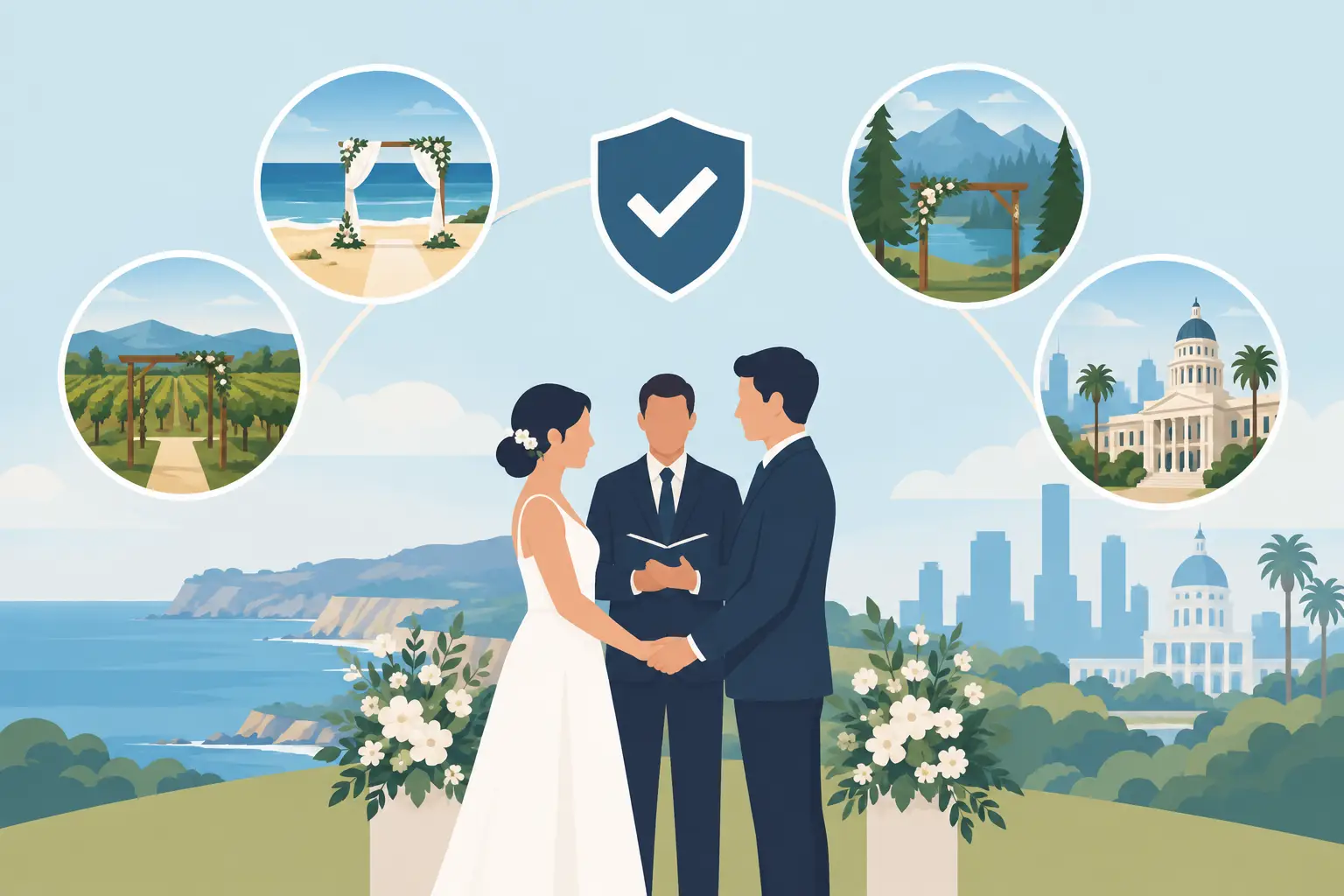
A courthouse hallway, a private chapel, a beach at sunset, a hotel suite, or your own backyard can all be part of a real California marriage. The question, does ceremony location affect validity, has a reassuring answer for most couples: the setting alone does not make or break the marriage. What matters is whether the legal requirements are completed correctly.
That distinction is especially helpful when time is tight. If you want to get married today in Los Angeles, you should be able to choose a place that feels like you – without wondering whether a beautiful, private, or unconventional location will create a problem later.
Does ceremony location affect validity in California?
Generally, no. In California, a marriage is not valid simply because it happened at a courthouse, and it is not invalid because it happened somewhere more personal. A legally recognized ceremony can take place at a chapel, residence, park, restaurant, hotel, event venue, or another suitable location within California.
The location becomes relevant when it affects the legal process. Your marriage license must be valid, the ceremony must occur within the time allowed by that license, the person performing the ceremony must be authorized, and the completed license must be returned for recording. If those pieces are handled properly, a non-courthouse ceremony can carry the same legal weight as one performed at a government office.
For couples using a California marriage license, the ceremony must take place in California. A Los Angeles County-issued license can generally be used elsewhere in the state, but it cannot be used for a ceremony in Nevada, Arizona, Mexico, or another state or country. Crossing a state line for the view may sound spontaneous, but it can require a different marriage process.
The legal details matter more than the backdrop
Think of the ceremony location as the stage, not the legal engine. The legal engine is the license, authorized officiation, proper completion of documents, and county recording.
A valid marriage license comes first
California requires couples to obtain a marriage license before the ceremony. The license is time-sensitive, so waiting until after the ceremony to solve the paperwork will not work. A ceremony performed without the required license may not create a legally valid marriage, even if it includes vows, rings, guests, and photographs.
California marriage licenses are generally valid for 90 days from issuance. That gives some couples room to plan, but it does not mean the paperwork can be signed casually months later. If you are marrying fast, getting the license and ceremony coordinated on the same day removes the risk of missed deadlines or separate appointments.
Your officiant must be authorized
A gorgeous venue does not replace an authorized officiant. California permits certain public officials, religious leaders, and legally authorized officiants to solemnize marriages. The officiant must complete the license accurately after the ceremony.
This is where a friend-led ceremony can become complicated. A friend may be perfect for a symbolic role or personal reading, but they cannot legally marry you unless they meet California’s authorization requirements. Many couples blend both needs: an authorized officiant completes the legal ceremony, while a loved one adds a personal moment.
The license must be completed and returned
After the ceremony, the signed marriage license needs to be returned to the appropriate county office for recording. Recording is the step that creates the official county record and allows you to request certified copies for name changes, immigration matters, military benefits, insurance, banking, and other legal needs.
A location does not change this requirement. Whether you marry in a VIP room or at a private residence, incomplete paperwork can delay proof of marriage. That is why couples facing a deadline should choose a process that includes clear document handling, not just an officiant who arrives for the ceremony.
When your chosen location can create a problem
Most location issues are practical rather than marital. You can be legally married in an intimate or unexpected place, but you still need permission to use the space and enough privacy and access for the ceremony to happen safely.
A public beach or park may require a permit, especially for a larger gathering, amplified music, decor, chairs, photography equipment, or reserved space. A restaurant or hotel may permit a simple ceremony but have rules about guests, noise, or timing. A private residence usually offers more flexibility, although homeowners or property managers may still have restrictions.
The key is not whether the space looks official. It is whether you have the right to be there and can complete the ceremony without interruption. If a venue asks you to leave, closes unexpectedly, or prohibits events, the legal ceremony may need to be moved or rescheduled. That is an avoidable stress point when you are ready to say “I do” now.
Weather also matters for outdoor ceremonies. Rain does not invalidate a California marriage, but a sudden change in conditions can make it difficult to gather, sign documents, or hear the officiant. A practical backup location keeps a romantic plan from becoming a time-sensitive problem.
Public, private, chapel, or mobile ceremony?
There is no one legally superior setting. The right choice depends on the experience you want and how much coordination you can take on.
A chapel ceremony is often the simplest option for couples who want privacy, a polished setting, and a clear legal process without venue logistics. It works especially well for elopements, destination visitors, military couples working against a departure date, and anyone who does not want to spend the day navigating traffic, permits, or courthouse lines.
A mobile ceremony lets the setting carry more of your story. Maybe that is your apartment, a favorite Los Angeles overlook, a family home, or a hotel where you are celebrating. It can feel deeply personal, but it may involve travel timing, parking, venue permission, and a weather backup. For a couple who has a meaningful location in mind, those trade-offs can be worth it.
A courthouse can be appropriate too, but it is not the only path to a valid marriage. Couples often assume government offices are required because they want legal certainty. In reality, certainty comes from following the correct California process, not from standing in a courthouse building.
A note on confidential marriage licenses
California also offers confidential marriage licenses for eligible couples. These have different privacy rules than public licenses, and the official record is not open to general public inspection. They are often appealing to couples who value discretion.
Because eligibility and procedures can differ, do not assume every location or every ceremony arrangement fits the same license type. If privacy is part of your decision, confirm the license requirements before choosing the ceremony plan. The goal is to protect both the moment and the paperwork behind it.
How to choose a location without slowing down your marriage
Start with the practical question: do you need to be legally married today, or are you planning ahead? If the answer is today, choose a setting that supports fast, accurate completion of the license and ceremony. A private chapel or organized mobile service often provides more certainty than trying to coordinate a public venue at the last minute.
Then consider what you want to remember. Some couples want a quiet room with just the two of them. Others want a photo-worthy Los Angeles backdrop, a few family members, or Spanish-language officiation so everyone present feels included. Your marriage can be both legally complete and emotionally personal.
Same-Day Marriage helps couples handle the full Los Angeles process in one coordinated plan: marriage license, legal ceremony, county recording, and support with certified proof of marriage. That means you are not left wondering who has the paperwork, where it goes next, or whether a non-courthouse ceremony counts.
Your venue should support your love story, not put it on hold. Choose a location you are allowed to use, complete the California legal steps correctly, and let the setting be what it should be: the place where your marriage begins.