
If you searched “what documents are needed to marry in California,” the answer is refreshingly simple for most adult couples: valid photo ID, both partners present for the license, and accurate information about any prior marriages. You do not need to wait for a big wedding to make your love legal. In Los Angeles, couples can handle the license, ceremony, recording, and next steps in one focused day when they arrive prepared.
The core documents needed to marry in California
For a standard California marriage license, each person should bring a valid, government-issued photo ID. A current driver’s license, state ID card, passport, military ID, or other official identification is typically accepted. The key is that the document clearly shows your legal name, photograph, and date of birth.
Both people must be at least 18 years old to marry without additional court involvement. You must also appear together when applying for the marriage license. A friend, family member, planner, or partner cannot apply on your behalf, even if the ceremony will happen later that day.
Most couples do not need a birth certificate to obtain a California marriage license. You also do not need a blood test, proof of residency, a California address, or United States citizenship. California welcomes couples who live in another state or another country, as long as they meet the licensing requirements and can provide acceptable identification.
The application will ask for personal details, including your full legal names, dates and places of birth, parents’ names, and Social Security numbers if you have them. Bring the information you know, and take a moment to review every spelling before the license is issued. Small errors can create unnecessary work when you later request certified copies or update records.
If one or both of you were married before
A previous marriage does not prevent you from getting married in California, but it does mean you should be ready with the date the prior marriage ended. That could be the date of divorce, death, or annulment.
For many license applications, you will be asked to state how and when the prior marriage ended. A certified divorce judgment or death certificate is not always required at the counter, but requirements and follow-up questions can vary by county and by your circumstances. If your divorce was recent, complex, completed outside the United States, or you are unsure whether it is final, bring the relevant paperwork or ask before you go.
Do not rely on a separation agreement or an unfinished divorce filing. You must be legally free to marry on the day your new license is issued and your ceremony takes place. If there is any uncertainty, resolve it first. A fast marriage process still requires a legally valid foundation.
California marriage license requirements that surprise couples
The documents are only one part of the process. A California marriage license is valid for 90 days from the date it is issued, and the ceremony must happen within that window. It can be used anywhere in California, not just in the county where you obtained it.
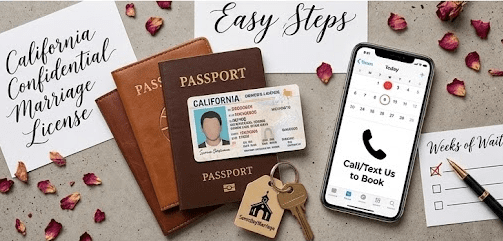
You will choose between a public marriage license and, if you qualify, a confidential marriage license. A public license is the standard option. It requires at least one witness to sign the marriage license at the ceremony, and the resulting record is public under California law.
A confidential license is available only if you and your partner are already living together as spouses. No witness is required, and the marriage record is not available to the public. Because this option has a specific eligibility rule, be truthful about your living arrangement and ask questions before selecting it.
Neither type of license means you are married by itself. You become legally married after an authorized officiant performs the ceremony and completes the license correctly. Then the completed license must be returned for county recording.
What to bring for your ceremony
Once your license is ready, the ceremony can be short, personal, traditional, private, or held at a meaningful location. The legal essentials are straightforward: a valid license, an authorized officiant, both partners, and a witness if you are using a public license.
For a public marriage license, your witness must be old enough to understand what they are signing. California does not impose a strict minimum age for the witness, but many providers prefer an adult witness to avoid complications. If you are eloping alone, confirm whether a witness can be arranged before the ceremony.
Bring your IDs with you to the ceremony even if you already showed them during licensing. It is also smart to bring any notes with the names, addresses, and parent information used on the application. The information written on the completed license should match the information on the issued license.
Official requirements are listed by Los Angeles County here:
https://www.lavote.gov/home/county-clerk/marriage-licenses-ceremonies/general-info/eligibility
If you want a meaningful ceremony without a long planning timeline, decide on two simple things before you arrive: the names you want the officiant to use and whether you want personal vows. A legally complete ceremony can still feel like yours. Some couples exchange rings, invite one or two loved ones, take photos afterward, or keep the moment entirely private.
International couples and out-of-state visitors
You do not need to be a California resident to marry here. Visitors from every U.S. state and international couples can legally marry in California if they meet the state’s requirements.
A valid foreign passport is commonly the clearest ID option for international visitors. If your documents are not in English, a certified translation may be useful or requested, depending on the issuing country and licensing office. Names should be entered exactly as they appear on your identification. If there are multiple surnames, hyphens, accents, or differences between documents, ask how they will be recorded before signing the application.
The marriage itself is legally valid when completed under California law. Using the marriage certificate abroad, however, may involve extra steps such as a certified copy, apostille, translation, or registration with another country. Those are separate from getting legally married in California, so plan for them if immigration, international travel, or foreign government records are involved.
A practical same-day checklist
Before you leave for your license and ceremony, confirm that you have these essentials:
- A valid government-issued photo ID for each partner
- Accurate personal information for the marriage license application
- The date each prior marriage ended, if either partner was married before
- A witness for a public-license ceremony, if one is not being provided
- Payment for your selected license and ceremony services
If either person is under 18, incarcerated, unable to appear, has an unresolved prior marriage, or has identification that is expired or damaged, do not assume the standard process will apply. Minor marriages require court approval and additional documentation. Special circumstances deserve an answer before you make plans for the day.
After the ceremony: recording and proof of marriage
The signed marriage license is returned to the appropriate county recorder for recording. That recording step matters. It creates the official marriage record that allows you to order certified copies, which are commonly needed for name changes, benefits, insurance, immigration filings, military records, and other legal updates.
A ceremonial certificate or keepsake document can be beautiful, but it is not always the same as a certified copy of the recorded marriage certificate. Ask clearly what proof you will receive, when the license will be recorded, and how certified copies are handled. Couples facing an urgent deadline should make this part of the plan, not an afterthought.
For couples who want the process handled without courthouse lines and separate appointments, Same-Day Marriage can coordinate the legal steps from license through ceremony and recording support in Los Angeles. The goal is not to rush the meaning of the moment. It is to remove the administrative friction that stands between you and a legally recognized marriage.
Love does not need a six-month timeline to be real. Bring the right ID, be honest and precise on your license information, and choose a process that gives your ceremony both the feeling and the legal certainty it deserves.